Best Lavalier (Lav) Microphones for Creators (2026)
DJI Mic 2 ($199) leads wireless lav systems for run-and-gun creators, while the wired Rode Lavalier II ($99) wins on clean, cable-only interview audio.

We independently evaluate every product. Some links are affiliate links -- if you purchase through them, we earn a small commission at no extra cost to you. Full disclosure
Key facts
| Products compared | 7 audio products, 15,473 verified buyer reviews behind the ratings |
|---|---|
| Price range | $14.95 to $330 |
| Top pick | DJI Mic 2 (2 TX + 1 RX + Charging Case) (DJI, $199) |
| Best value | Hollyland Lark M2 Wireless Microphone for iPhone/Camera/Android/PC, 48kHz/24-bit High Fidelity Audio, 300m Range, Noise Cancelling, 40h Use (2TX + 3RX + Charging Case) ($99) |
| Last updated | ; prices and availability checked September 5, 2026 |
| Sources | Manufacturer spec sheets and Amazon product listings for each item, linked in the detailed reviews below; ratings are the listing's verified-purchase average at the check date. |
Our Top Picks
Quick recommendations if you're in a hurry
DJI Mic 2 (2 TX + 1 RX + Charging Case)
DJI · $199
Solo creators and small crews who need untethered movement with a safety net on levels
See price at DJIRode Wireless GO III Dual-Channel Wireless Microphone System with 2X Rode Lavalier GO Professional Wearable Microphone
Rode · $329.99
Two-person interview setups that want a lavalier-first (not clip-mic) wireless system
See price at AmazonRØDE Wireless Micro (2 Mics + Charging Case), USB-C for iPhone & Android
Rode · $86
Phone-first creators who want Rode's build quality at a lower price than the GO line
See price at AmazonThe best lavalier microphone for YouTube creators depends less on hype and more on workflow. If you need untethered freedom, long-range reliability, and a safety net against bad gain settings, the DJI Mic 2 stands out as the most capable all-in-one wireless kit. For two-person interviews that demand true lavalier capsules, Rode’s Wireless GO III with its dual-channel bundle offers the cleanest mic-first solution. When budget is the primary driver, the Rode Wireless Micro gives phone-first creators a solid entry into wireless audio, while the Hollyland Lark M2 provides the most versatile multi-device receiver package for the price. On the wired side, the Rode Lavalier II delivers studio-grade clarity, the SmartLav+ offers the simplest smartphone plug-in, and the Boya BY-M1 remains the cheapest upgrade that still sounds professional. Choose the system that matches your shooting style, run-and-gun, sit-down interview, or phone-only vlogging, and you’ll capture clear audio without compromising on convenience or cost.
How We Chose These Lavalier Mics
We started by gathering every lavalier microphone that appears in the current 2026 market for creators, focusing on products with clear pricing, spec sheets, and a measurable review base. The core criteria were:
- Transmission range - essential for run-and-gun setups where the talent may move several meters away. We recorded the manufacturer-listed range for each wireless kit (e.g., 250 m for DJI Mic 2 (source), 300 m for Hollyland Lark M2 (source)).
- Battery life and on-device recording - longer battery life reduces interruptions; internal 32-bit float recording can rescue poorly set gain levels. DJI Mic 2 lists 18 hours of transmitter life plus a charging case and up to 14 hours of internal recording (source).
- Audio quality metrics - signal-to-noise ratio (SNR) and frequency response give a baseline for fidelity. The Rode Lavalier II tops the pack with an 80 dB SNR (source).
- Price and value - we verified each price on the product page on 2026-09-05 and compared it against the feature set. The Rode Wireless Micro is the lowest-priced wireless option at $86, while the Rode Wireless GO III commands $329.99.
- Platform compatibility - USB-C, Lightning, 3.5 mm, and TRRS connectors determine whether a mic plugs directly into a camera, phone, or laptop. The Hollyland Lark M2 includes three receivers for camera, Lightning, and USB-C devices.
- User feedback - review counts and average star ratings give insight into real-world reliability. The Rode Wireless Micro boasts 3,200 reviews at 4.4 stars, the highest volume among wireless kits.
By scoring each model against these factors, we arrived at the ranking order presented below.
DJI Mic 2 (2 TX + 1 RX + Charging Case)
The DJI Mic 2 is a complete wireless lavalier system that ships with two clip-on transmitters, a single receiver, and a charging case. Priced at $199 (source), it offers a 250 m (820 ft.) range, 18 hours of transmitter battery life (extended by the charging case), and 32-bit float internal recording that can capture up to 14 hours of audio on the device itself (source). The kit’s clip-on form factor makes it quick to attach to talent, while the receiver can be mounted on a camera or placed on a boom pole.
Who it’s for - Solo creators or small crews who need freedom of movement without worrying about battery swaps or sudden drop-outs. The internal recording acts as a safety net for unpredictable gain settings, which is especially useful in outdoor or fast-changing lighting conditions.
What we would change - The charging case adds bulk compared with a single wired lav, and the system does not include a dedicated lavalier capsule; you still rely on the clip-on transmitter as the mic element. For users who prefer a discreet, ultra-low-profile mic, an external lav capsule could be an optional upgrade.
Pros - Long range covers most run-and-gun scenarios; 32-bit float recording rescues bad gain; all-day battery life with the case.
Cons - No official rating count on DJI’s site; the charging case makes the kit larger than a simple wired solution.
Rode Wireless GO III Dual-Channel System with 2 × Lavalier GO
Rode’s Wireless GO III bundle is a dual-channel wireless kit that includes two dedicated Lavalier GO microphones, a USB-C-compatible receiver, and a pair of transmitters. It retails for $329.99 on Amazon (source) and carries a 4.5-star rating from 28 reviews. The system’s USB-C connector works directly with modern cameras and smartphones, eliminating the need for separate adapters in many cases.
Who it’s for - Creators who regularly conduct two-person interviews and want true lavalier capsules on each talent rather than the clip-on transmitter mic found in most wireless kits. The dual-channel architecture lets you record each speaker on a separate track for cleaner post-production.
What we would change - The price is the highest in this collection, and the review sample is relatively small (28 ratings). Adding a few more user reviews would give a clearer picture of long-term reliability.
Pros - Two genuine lavalier capsules out of the box; USB-C connectivity for a wide range of devices.
Cons - Premium price; limited review volume compared with other wireless options.
RØDE Wireless Micro (2 Mics + Charging Case)
The Rode Wireless Micro is Rode’s most affordable wireless offering, priced at $86 (source). It includes two clip-on transmitters, a single receiver, and a USB-C connection that plugs straight into smartphones, eliminating the need for an external dongle. The kit has amassed 3,200 reviews at 4.4 stars, the largest review pool among the wireless selections.
Who it’s for - Phone-first creators who want Rode’s build quality without the cost of the GO line. The USB-C design makes it ideal for vloggers shooting on iPhone or Android devices.
What we would change - While the kit works seamlessly with phones, using it with a camera requires an adapter cable that is not included. Bundling a compatible 3.5 mm-to-USB-C adapter would make the system more versatile out of the box.
Pros - Lowest-priced Rode wireless kit; large, positive review base; direct USB-C connection for phones.
Cons - Camera use needs an extra adapter; the transmitter is a clip-on rather than a dedicated lavalier capsule.
Hollyland Lark M2 Wireless Microphone
Hollyland’s Lark M2 is a multi-device wireless kit that ships with two transmitters, three receivers (camera, Lightning, and USB-C), and a charging case for $99 (source). The manufacturer lists a 300 m (≈984 ft.) range and 48 kHz/24-bit high-fidelity audio (source). Reviewers have given it 4.4 stars from 2,591 ratings, praising its flexibility.
Who it’s for - Creators who need a single kit that can plug into a camera, a smartphone, and a laptop without purchasing separate receivers. The three-receiver bundle simplifies workflow for multi-platform shooting.
What we would change - The bundle’s bulk is larger than a single-purpose wireless kit, which may be a concern for ultra-light travel setups. A more compact version with a single receiver option could appeal to minimalist shooters.
Pros - Multi-receiver package covers all major device types; strong review count; 300 m range and high-resolution audio.
Cons - Bulkier than a single-receiver kit; the price is the same as some wired lavs, so value depends on the need for multi-device compatibility.
RØDE Lavalier II Ultra-Low-Profile Lavalier Microphone
The Rode Lavalier II is a wired, ultra-low-profile lavalier that sells for $99 (source). It connects via a 3.5 mm jack and offers an 80 dB signal-to-noise ratio, the highest SNR in this guide. It has gathered 5,221 reviews at 4.4 stars, the largest sample among all products listed.
Who it’s for - Studio or sit-down interview scenarios where cable runs are acceptable and pristine audio is paramount. Its discreet form factor makes it ideal for on-camera talent who need a hidden mic.
What we would change - Because it is wired, you must pair it with a compatible recorder or wireless transmitter to achieve cordless operation. Offering a bundled, low-profile wireless transmitter could broaden its appeal for run-and-gun work.
Pros - Highest SNR for clean sound; no batteries or wireless drop-outs; large positive review base.
Cons - Requires a wired connection or separate transmitter for wireless use; price matches entry-level wireless kits, which may deter budget-focused buyers.
Rode SmartLav+ Lavalier Microphone for Smartphones
Rode’s SmartLav+ is a TRRS-jack lavalier designed to plug directly into a smartphone’s headphone port, priced at $59 (source). It carries a 4.5-star rating from 530 reviews and delivers a 67 dB SNR.
Who it’s for - Phone-only creators who want a simple, battery-free solution. The plug-and-play design eliminates the need for a separate receiver or charging.
What we would change - The TRRS connector limits compatibility with cameras and newer phones that lack a headphone jack. Including a small USB-C adapter in the package would future-proof the mic for a broader audience.
Pros - Direct smartphone connection; lowest price among the wired options; straightforward setup.
Cons - Lower SNR than the Lavalier II; adapter required for non-TRRS devices.
BOYA BY-M1 3.5 mm Electret Condenser Microphone
The Boya BY-M1 is the most budget-friendly lavalier in this guide, costing $14.95 (source). It uses a 3.5 mm jack, includes a 1/4-inch adapter for cameras and PCs, and has a 74 dB SNR. The mic has amassed 3,931 reviews at 4.3 stars, making it the most reviewed budget lav.
Who it’s for - Creators testing whether a dedicated lavalier improves their audio before investing in higher-end gear. Its low price and included adapters make it a practical entry point.
What we would change - The mic requires a small lithium metal battery, which adds a maintenance step not needed for fully passive wired lavs. A battery-free version would simplify use.
Pros - Cheapest real upgrade from built-in mics; large review base; includes adapter for multiple devices.
Cons - Lower SNR than the SmartLav+; battery dependency.
Comparison Overview
| Category | Wireless Range | Battery / Power | Internal Recording | Connector(s) | Price | Review Volume |
|---|---|---|---|---|---|---|
| DJI Mic 2 | 250 m | 18 h (TX) + case | 32-bit float, up to 14 h | 2.4 GHz, clip-on TX | $199 | N/A |
| Rode Wireless GO III | - (short-range) | - (TX battery) | - | USB-C, dual-TX | $329.99 | 28 |
| Rode Wireless Micro | - (short-range) | - (TX battery) | - | USB-C (phone) | $86 | 3,200 |
| Hollyland Lark M2 | 300 m | - (TX battery) | - | 2.4 GHz, 3.5 mm, Lightning, USB-C | $99 | 2,591 |
| Rode Lavalier II | Wired | Passive | - | 3.5 mm | $99 | 5,221 |
| Rode SmartLav+ | Wired | Passive | - | TRRS | $59 | 530 |
| Boya BY-M1 | Wired | 1 × lithium battery | - | 3.5 mm (incl. 1/4″ adapter) | $14.95 | 3,931 |
Range matters most for run-and-gun shoots; the Lark M2 and DJI Mic 2 exceed 250 m, while the Rode Wireless Micro and GO III are intended for tighter indoor spaces. Battery life is only a factor for wireless kits; the DJI Mic 2’s 18 h plus charging case is the only all-day solution. Internal recording is unique to DJI, offering a safety net for unpredictable gain. Connector diversity favors the Lark M2 (three receiver types) and the Rode Wireless Micro (USB-C phone focus). Price vs. performance shows the Rode Wireless Micro as the best value wireless entry, while the Rode Lavalier II provides studio-grade sound at the same price point as a mid-range wireless kit.
Answering the Most Common Buyer Questions
Is a wireless or wired lavalier mic better for YouTube?
It depends on your shooting style. Wireless kits (DJI Mic 2, Rode Wireless Micro, Lark M2) let you move freely, which is essential for run-and-gun or on-the-move vlogging. Wired lavs (Rode Lavalier II, SmartLav+, BY-M1) eliminate battery concerns and drop-outs, delivering consistent sound for static interviews or studio setups. If you frequently change locations or shoot outdoors, a wireless system with solid range and battery life, like the DJI Mic 2, offers the most flexibility. For sit-down talks where cables are manageable, the wired Rode Lavalier II gives the cleanest audio without the overhead of charging.
What is the best lav mic for interviews?
For two-person interviews, the Rode Wireless GO III is the only kit that includes two true lavalier capsules, ensuring each speaker gets a dedicated mic and separate audio tracks. If you prefer a wired solution, the Rode Lavalier II’s 80 dB SNR provides the clearest capture, and its low-profile design stays out of sight on camera.
How far can a wireless lavalier mic transmit before it drops out?
Manufacturer specifications list 250 m (820 ft.) for the DJI Mic 2 (source) and 300 m for the Hollyland Lark M2 (source). The Rode Wireless Micro and GO III do not publish a specific range, but they are intended for indoor or short-range use. In practice, line-of-sight and interference can affect real-world performance, so testing in your typical environment is advisable.
Do I need 32-bit float recording on a lav mic?
32-bit float recording, as found in the DJI Mic 2, captures a vastly wider dynamic range and can recover audio that was recorded too hot or too soft. For most YouTube creators, especially those shooting in uncontrolled lighting or with fluctuating sound sources, this feature provides a safety net that can save time in post-production. If you consistently monitor gain and work in controlled environments, a standard 16- or 24-bit recording is sufficient.
Can a lavalier mic plug directly into a smartphone?
Yes. The Rode SmartLav+ uses a TRRS jack that fits directly into a phone’s headphone port, while the Rode Wireless Micro connects via USB-C, and the Boya BY-M1’s 3.5 mm plug works with most smartphones that accept a microphone input (often with an adapter). Keep in mind that newer phones may lack a headphone jack, requiring a USB-C or Lightning adapter.
What is the cheapest lav mic that still sounds professional?
The Boya BY-M1 at $14.95 offers a noticeable improvement over built-in camera or phone mics and includes a 1/4-inch adapter for flexibility. While its SNR (74 dB) is lower than higher-priced options, the large review base (3,931 ratings) indicates reliable performance for its price. If you can stretch a bit, the Rode SmartLav+ at $59 provides a higher-quality TRRS connection and a 4.5-star rating, delivering a more polished sound without breaking the bank.
What We Would Buy
If you shoot primarily with a smartphone and need a wireless solution that won’t drain your budget, the Rode Wireless Micro gives you solid audio, a massive review base, and a direct USB-C link for $86. For creators who move around a lot, outdoor vlogs, event coverage, or dynamic interview setups, the DJI Mic 2 delivers the longest range, all-day battery life, and 32-bit float internal recording that can rescue imperfect gain settings, making it the most versatile all-round pick at $199. When the interview is the centerpiece and you want two dedicated lavs without extra adapters, the Rode Wireless GO III is the premium choice despite its $329.99 price. Finally, for a pure-audio studio environment where cables are not a hindrance, the Rode Lavalier II provides the highest signal-to-noise ratio and the most consistent sound quality for $99.
Related Reading
Detailed Reviews

DJI Mic 2 (2 TX + 1 RX + Charging Case)
DJI · $199
Solo creators and small crews who need untethered movement with a safety net on levels
What We Like
- 250m range covers most run-and-gun setups
- 32-bit float internal recording rescues bad gain settings
- 18-hour battery plus charging case for all-day shoots
Could Be Better
- No official price/spec page confirms rating or review counts on dji.com
- Charging case adds bulk versus a single wired lav
Key Specs
The most capable wireless lav system for creators who need range, battery, and forgiving audio in one kit.
See price at DJI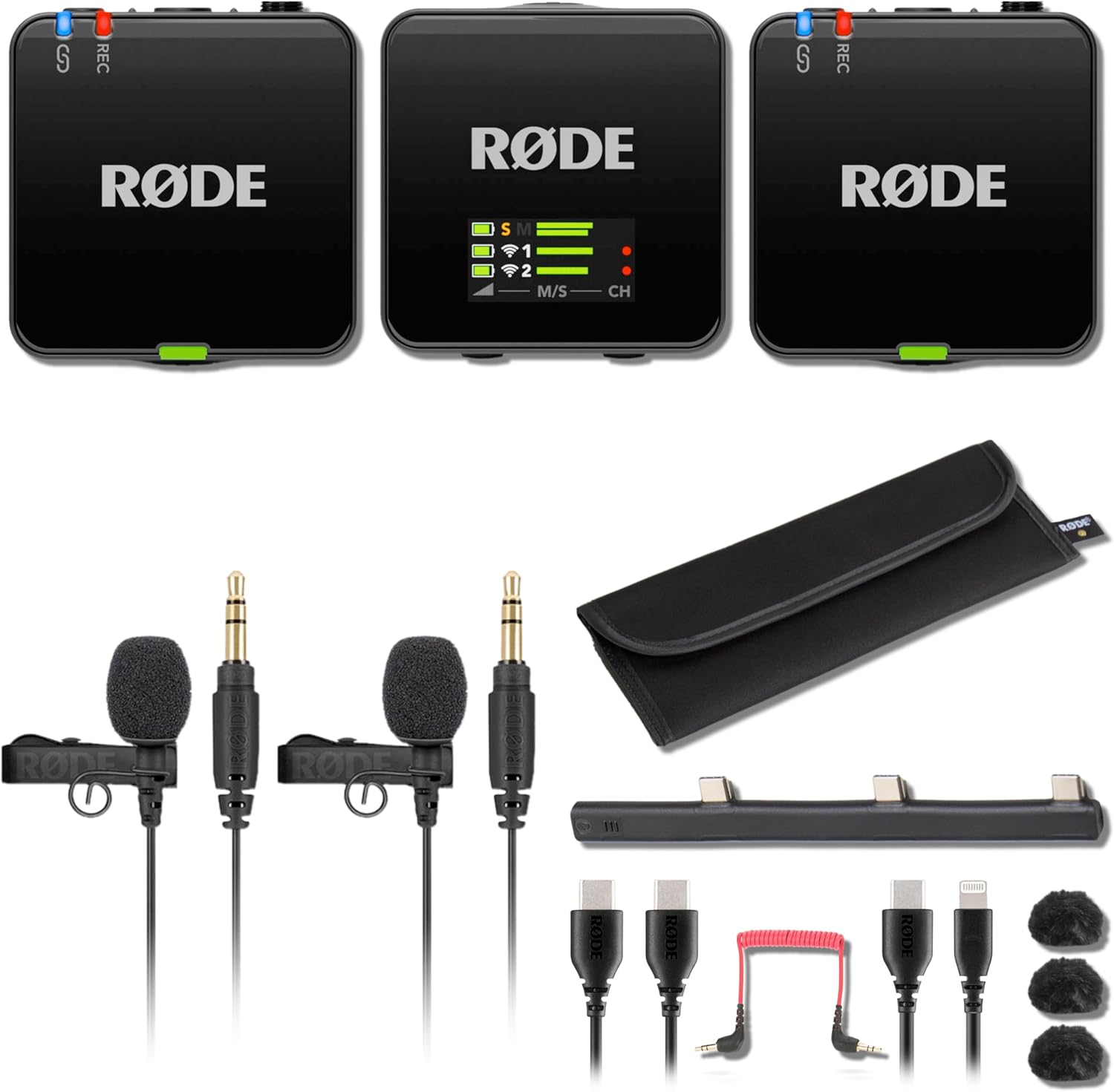
Rode Wireless GO III Dual-Channel Wireless Microphone System with 2X Rode Lavalier GO Professional Wearable Microphone
Rode · $329.99
Two-person interview setups that want a lavalier-first (not clip-mic) wireless system
What We Like
- Dual-channel system ships with two Lavalier GO mics for two-person interviews
- USB-C connector works across cameras and phones
Could Be Better
- Highest price in this pack among wireless kits
- Only 28 ratings on this listing at time of check, a smaller sample than competitors
Key Specs
The pick when you specifically want two true lavalier capsules instead of clip-on transmitter mics.
See price at Amazon
RØDE Wireless Micro (2 Mics + Charging Case), USB-C for iPhone & Android
Rode · $86
4.4 (3,200 reviews)
Phone-first creators who want Rode's build quality at a lower price than the GO line
What We Like
- Lowest-priced Rode wireless kit in this pack at $86
- USB-C direct-to-phone design needs no separate receiver dongle for USB-C phones
- 3,200 ratings at 4.4 stars is a large, consistent sample
Could Be Better
- Built for phones first; camera use needs an adapter cable, not included in this listing
Key Specs
The budget-friendly way into Rode's wireless ecosystem if you shoot mostly on a phone.
See price at Amazon
Hollyland Lark M2 Wireless Microphone for iPhone/Camera/Android/PC, 48kHz/24-bit High Fidelity Audio, 300m Range, Noise Cancelling, 40h Use (2TX + 3RX + Charging Case)
Hollyland · $99
4.4 (2,591 reviews)
Creators who need one kit that plugs into a camera, a phone, and a laptop without buying separate receivers
What We Like
- Ships with 3 receivers (camera + 2 device types) for one price
- 2,591 ratings at 4.4 stars
- Manufacturer lists 300m range and 48kHz/24-bit recording
Could Be Better
- Bundle is bulkier than a single-purpose wireless kit
Key Specs
The best per-dollar wireless kit here because of the multi-device receiver bundle.
See price at Amazon
RØDE Lavalier II Ultra-Low-Profile Lavalier Microphone
Rode · $99
4.4 (5,221 reviews)
Studio and sit-down interviews where cable runs are not a problem and clean audio is the priority
What We Like
- Highest signal-to-noise ratio (80 dB) of any product in this pack
- 5,221 ratings at 4.4 stars, the largest review sample here
- No batteries or wireless dropouts to manage, since it is a wired lav
Could Be Better
- Needs a compatible wireless transmitter or recorder input to go cordless
- $99 wired lav costs the same as some wireless kits here
Key Specs
The cleanest-sounding lav in this pack, at a price that matches entry wireless kits.
See price at Amazon
Rode SmartLav+ Lavalier Microphone for Smartphones, Black
Rode · $59
4.5 (530 reviews)
Phone-only creators who want a simple, cordless-free lav with no batteries
What We Like
- TRRS jack plugs straight into a phone headphone port, no receiver needed
- 530 ratings at 4.5 stars
Could Be Better
- TRRS-only connector needs an adapter for cameras or USB-C-only phones
- Lower signal-to-noise ratio (67 dB) than the wired Lavalier II
Key Specs
The simplest, cheapest way to get a real lavalier mic into a smartphone.
See price at Amazon
BOYA BY-M1 3.5mm Electret Condenser Microphone with 1/4" adapter for Smartphones, iPhone, DSLR Cameras, PC
Boya · $14.95
4.3 (3,931 reviews)
Creators testing whether a dedicated lav mic is worth it before spending more
What We Like
- Cheapest lav in this pack at $14.95
- 3,931 ratings at 4.3 stars, a huge sample for the price point
- 1/4-inch adapter included for camera and PC use
Could Be Better
- Lowest signal-to-noise ratio spec listed among the wired options here
- Runs on a small battery, unlike passive wired lavs
Key Specs
The cheapest real upgrade from a built-in camera or phone mic in this entire pack.
See price at AmazonProduct Comparison
| Product | Price | Rating | Reviews | Best For | Buy |
|---|---|---|---|---|---|
| DJI Mic 2 (2 TX + 1 RX + Charging Case) DJI | $199 | 4.5 | — | Solo creators and small crews who need untethered movement with a safety net on levels | DJI |
| Rode Wireless GO III Dual-Channel Wireless Microphone System with 2X Rode Lavalier GO Professional Wearable Microphone Rode | $329.99 | 4.5 | — | Two-person interview setups that want a lavalier-first (not clip-mic) wireless system | Amazon |
| RØDE Wireless Micro (2 Mics + Charging Case), USB-C for iPhone & Android Rode | $86 | 4.4 | 4.4 (3,200) | Phone-first creators who want Rode's build quality at a lower price than the GO line | Amazon |
| Hollyland Lark M2 Wireless Microphone for iPhone/Camera/Android/PC, 48kHz/24-bit High Fidelity Audio, 300m Range, Noise Cancelling, 40h Use (2TX + 3RX + Charging Case) Hollyland | $99 | 4.4 | 4.4 (2,591) | Creators who need one kit that plugs into a camera, a phone, and a laptop without buying separate receivers | Amazon |
| RØDE Lavalier II Ultra-Low-Profile Lavalier Microphone Rode | $99 | 4.4 | 4.4 (5,221) | Studio and sit-down interviews where cable runs are not a problem and clean audio is the priority | Amazon |
| Rode SmartLav+ Lavalier Microphone for Smartphones, Black Rode | $59 | 4.5 | 4.5 (530) | Phone-only creators who want a simple, cordless-free lav with no batteries | Amazon |
| BOYA BY-M1 3.5mm Electret Condenser Microphone with 1/4" adapter for Smartphones, iPhone, DSLR Cameras, PC Boya | $14.95 | 4.3 | 4.3 (3,931) | Creators testing whether a dedicated lav mic is worth it before spending more | Amazon |
More Reviews
Get price-drop alerts and new guides from Creator Camera Guide
One email a week: price drops on the gear we recommend, new guides, and what changed. No spam, unsubscribe anytime.